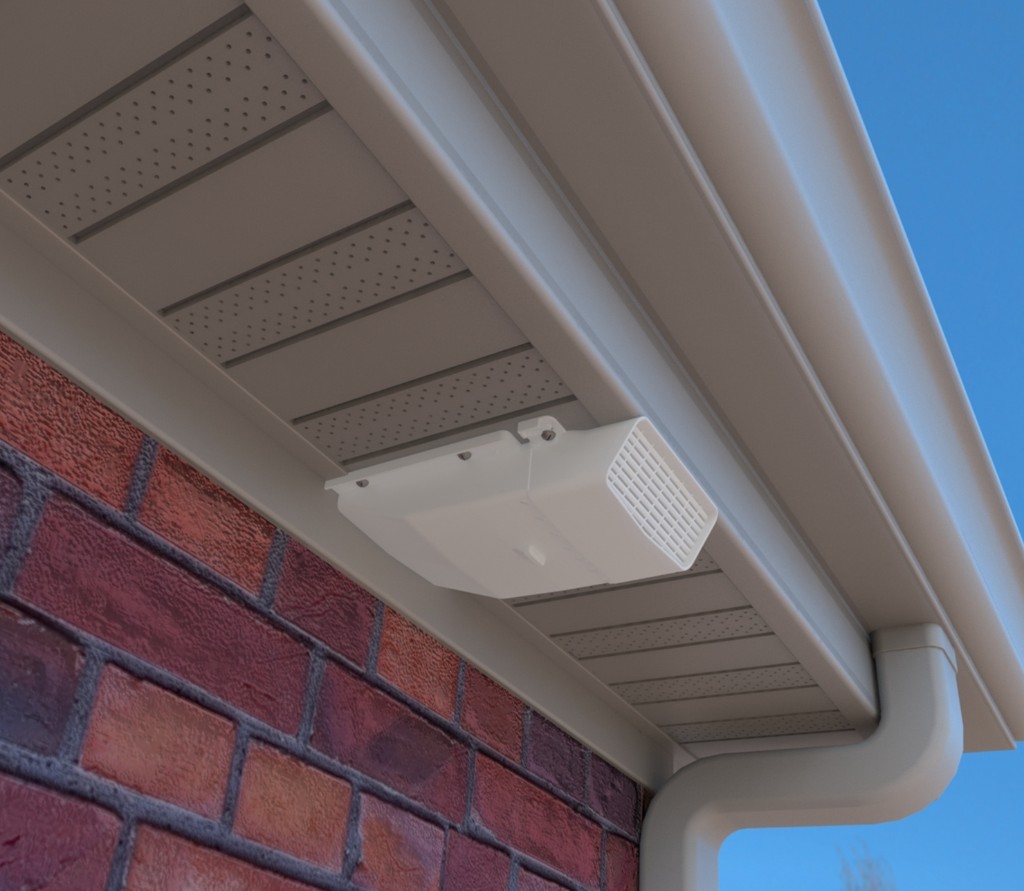
Introducing the PreVentIt bathroom exhaust soffit vent
Unlike standard soffit vents that dump moist air under the eave, our soffit vent directs the exhausted air beyond the eave - preventing the exhausted air from entering the attic, which can cause moisture damage and mold growth.
Directional discharge that pushes exhaust past the soffit's passive airstream
Built-in damper to block pests and backdrafts
Removable screen for easy cleaning
Engineered specifically for bathroom fan applications
PreVentIt Soffit Vent prevents black mold from developing in the attic space, which can occur by improperly venting bath fans to the soffit. By preventing moisture build-up in the attic and potential black mold growth, you reduce health risks for both humans and pets.
Health issues associated with exposure to black mold
PREVENTITAdvancing home building, one smarter product at a time
Technical Documentation
Soffit Vent Technical Memorandum
Validated performance, laboratory testing, and CFD analysis for the PreVent-It Soffit Vent.
1. Executive Summary
The PreVent-It Soffit Vent, manufactured by Novelty Manufacturing Company (Lancaster, Pennsylvania), is a patented, directional bath fan exhaust termination device engineered to discharge air beyond the soffit's passive airstream, preventing attic re-entrainment. Its validated performance, certified laboratory testing, and computational fluid dynamics (CFD) analyses demonstrate full compliance with the intent and performance requirements of Building Code IRC M1501.1, and IMC 501.3.1(3). This technical memorandum documents the PreVent-It Soffit Vent as a novel venting solution that delivers superior performance compared to conventional soffit vent terminations. It demonstrates the vent's effectiveness in preventing moisture accumulation and airflow backdrafting into the attic while maintaining compliance with applicable mechanical and residential code intent.
2. Product Overview & Function
Product Name
PreVent-It Soffit Vent
Model
4250X
Manufacturer
Novelty Manufacturing Company, Lancaster, PA
Patents
U.S. Patent No. 10,731,891 — Directional Exhaust Ventilation System, issued August 4, 2020
U.S. Patent No. 12,000,612 B2 — Improved Ventilation Termination Assembly, issued June 4, 2024
Primary Code Objective
Ensure exhaust air is discharged to the outdoors without risk of re-entrainment into the attic, condensation, or structural degradation.
Design Features
Aerodynamic internal geometry directs exhausted air out of the soffit's passive airstream and beyond the soffit's edge.
Compatible with 3"–4" ducts, adaptable to multiple bathroom exhaust fan types.
Eliminates need for draft blocking on either side of vent due to effective exhaust air displacement out of the soffit's passive airstream.
3. Testing & Technical Validation
a. Laboratory Testing
Riverside Energy Efficiency Laboratory (Texas A&M) — Independent testing (Contract No. 22-1312A) confirmed airflow performance of the SV001 under ANSI/AMCA 210-16, ASHRAE 51-16, and HVI 915/916/920 standards.
Results Summary
Stable airflow across a broad range of static pressures.
Confirms durability and non-choking geometry under standardized testing.
Provides objective, third-party airflow validation for code documentation.
What It Does Not Show
It does not simulate wind effects or attic crossflow (addressed separately via CFD). It does not measure temperature or humidity transport. It does not equate to field system pressures—those are covered in Field Testing. Note: standardized chamber set points used for laboratory accessory testing under ANSI/AMCA 210 and ASHRAE 51 methods do not represent typical in-field operating pressures. Higher pressures are part of the nozzle method used to evaluate component performance consistency rather than real-world operating conditions.
b. Computational Fluid Dynamics (CFD) Analysis
A comprehensive Computational Fluid Dynamics (CFD) study was conducted using ANSYS CFX to compare the airflow, velocity magnitude, and thermal dispersion among three configurations: the PreVent-It Soffit Vent, a conventional soffit vent, and a gable wall vent. The analysis examines airflow discharge characteristics and interaction patterns within a fully simulated indoor–outdoor environment representing attic and exterior conditions. Boundary conditions included inlet velocities between 5–15 mph, constant 75°F ambient temperature, and constant 95°F attic temperature. Airflow input into soffit vent: 60 CFM. Duct diameter: 4". Comparative models maintained identical duct geometry and airflow inputs for consistent benchmarking.
PreVent-It Soffit Vent
Airflow fully exits the soffit plane with a tight, laminar discharge plume directed outward. Velocity vectors demonstrate that the exhaust column clears the soffit edge, achieving >95% displacement efficiency.
Conventional Soffit Vent
Exhibits significant turbulence and backflow under attic sheathing at 10–15 mph ambient crossflow. Resulting velocity contours reveal re-entrainment of moist exhaust air into the attic ventilation path, violating the intent of IRC M1501.1.
Gable Wall Vent
While discharging outward, the gable configuration showed stratified recirculation zones along the roofline, with reduced horizontal dispersion efficiency and partial attic re-exposure during low-wind conditions.
CFD imagery demonstrates that the PreVent-It Soffit Vent achieves complete exhaust separation from the soffit's passive airstream, outperforming both the conventional soffit and gable vents when installed under a soffit. These results confirm its compliance with the intent of IMC 501.3.1(3) and IRC M1501.1 by ensuring environmental air exhausts directly outdoors without attic re-entrainment via the soffit's passive airstream.
c. Visual and Performance Evidence
Further CFD renderings show velocity vectors and moisture concentration fields: Moisture Density Field: no attic moisture accumulation. Velocity Vector Field: exhaust stream displaced beyond soffit intake zone.
d. Field Flow Testing (6/11/2024)
Field testing (June 11, 2024) confirmed real-world equivalence to CFD models, with flow displacement patterns fully exiting the soffit plane and no observable moisture recirculation. Average measured airflow for the PreVent-It Soffit Vent was approximately 72 CFM. Measurements were taken at the fan housing using a calibrated flow hood and digital manometer (DG1000).
4. Code Equivalency Justification
IMC 501.3.1(3): Environmental air exhaust must terminate 3 ft from operable openings and 10 ft from intakes. IRC M1501.1: Exhaust air shall not discharge into an attic, soffit, ridge vent, or crawl space.
Compliance Argument
The PreVent-It Soffit Vent discharges fully to the outdoors, meeting IRC M1501.1.
Discharge occurs beyond soffit plane, preventing any attic air entrainment (meets intent of IMC 501.3.1(3)).
Certified test data and CFD analyses confirm superior safety, efficiency, and moisture control compared to conventional soffit vents.
Installation meets clearance requirements and enhances building envelope integrity by avoiding exhaust air re-entrainment caused by conventional soffit vents.
5. Conclusion
The PreVent-It Soffit Vent meets the intent, performance, and safety criteria established by applicable building and mechanical codes governing exterior air exhaust terminations. Its directional geometry eliminates re-entrainment, protects structural components from moisture exposure, and provides a tested, verifiable, and code-compliant means of bathroom exhaust venting through the soffit without the risk of re-entrainment of the exhausted air into the attic.
Supporting Documentation (upon request)
Riverside Energy Efficiency Laboratory Test Report (22-1312A)
Soffit Vent CFD Report 2023
Soffit Vent Field Study Testing Report 6.11.24
Soffit Vent Science Presentation 2023
U.S. Patent Nos. 10,731,891 and 12,000,612 B2
ICC
INTERNATIONAL
CODE COUNCILBuilding safety
Standards for Ventilation
The International Code Council (ICC) requires that all bathroom exhaust fans be vented to the exterior of a structure.
Chapter 15: Exhaust Systems Section M1507
“Mechanical Ventilation – 1507.2 Recirculation of Air:
“Exhaust air from bathrooms and toilet rooms shall not be recirculated within a residence or to another dwelling unit and shall be exhausted directly to the outdoors.”
Protect your home from hidden moisture damage
Upgrade to the PreVentIt 4" soffit vent—free shipping in the lower 48, 60-day returns, made in the USA.